

Archive
- Behind the Screens 9
- Bright Young Things 16
- Colour Palette 64
- Dress Ups 60
- Fashionisms 25
- Fashionistamatics 107
- Foreign Exchange 13
- From the Pages of… 81
- G.U.I.L.T. 10
- Little Trifles 126
- Lost and Found 89
- Odd Socks 130
- Out of the Album 39
- Red Carpet 3
- Silver Screen Style 33
- Sit Like a Lady! 29
- Spin, Flip, Click 34
- Vintage Rescue 20
- Vintage Style 157
- Wardrobe 101 148
- What I Actually Wore 163
Queen of Knitwear

French designer Sonia Rykiel has been creating knits for thirty years. She began her career in 1962, when she was pregnant, motivated by the fact that she could not find any attractive maternity wear. It was in knitwear that she found her metier however; she wanted to ‘be the only unique woman of St Germain des Prés, dressed so that the rest seemed not to exist’. A very worthy motive indeed!
It was the ‘poor boy’ sweater that became her trademark with its tight, high-cut armholes. I own one of these in distinctive purple and red stripes, in a thin, almost semi-transparent wool, and can testify that the cut does give knitwear a sexy edge. I also have a couple of her pompom sweaters, the grey one above, and a multi-coloured striped knit with bell sleeves. All were bought from eBay stores.
Click and read the story below for a little history on the Queen of Knitwear.
 From British Marie Claire, Nov 1998; click image for larger version
Jolly Jewellery

I bought this humorous set of skull and crossbones jewellery on eBay. The skull and crossbones are most strongly associated with poison and danger, or of course the Jolly Roger, the pirate’s flag. “Danger! Be scared!” this symbol says, but I do like the way the irrepressibly wide grin and rhinestones contradicts this message. There’s a naughty twinkle in their eye that belies the warning. Too cute!
Haunted Hallowe’en
 Hallowe’en is not a holiday that is hugely celebrated in Australia, and I actually have no tradition of celebrating it. I know a few people here or there that hold parties, but it seems a pretty rare occurrence. So while I had not planned any costume, I did have some pictures up my sleeve that were rather haunting.
From time to time I like to play with the multiple exposure effect on my camera. There is actually a function to merge two existing photos for a similar effect, but I much prefer the random results of the real double exposure – the shutter is set to go off in a single burst, so I have to move quickly. After a few attempts I have more of a sense of the timing and can plan for the results a little better.
A while back I did a photoshoot of an Italian widow, and at the end took a series of multiple exposures. The house is one I photographed last year in Sintra, Portugal. Here are a few ghostly images that I was quite happy with.
Hope your Halloewe’en is hilarious, not harrowing!
 The original double exposure used in the image above
 Double exposure + addition of third image in Photoshop
  Single exposure
 Double exposure
 Two single exposures merged in Photoshop
How Sweet It Is
Celebrating the Roaring Twenties in a Special Series

 Boudoir cap, c. 1919I have always, always wanted to own an original 1920s boudoir cap. There are so many covetable 1920s garments, but these little confections must truly take the cake. They are the pinnacle of Twenties chic; the epitome of the darlingest flapper girl. And since I now have shorn my hair into a bob, there was no excuse not to buy one, especially when I found a pale pink silk and ecru lace version, trimmed with pink bows, for $15 on Etsy. I’ve looked at many online in the past, but I have never seen such an inexpensive original cap of the era.

Generally not worn overnight, the boudoir caps hid messy morning hair, or protected an elegant coiffure while dressing.
 Boudoir cap, 1920sIn the Victorian era, night caps were a little more hardy, made from cotton trimmed in lace. Then in the 1920s they were transformed: sewn from silk and lace, and trimmed with silk ribbons, bows and flowers.
They were usually worn first thing in the morning in the privacy of the bedroom. Generally not worn overnight, the boudoir caps hid messy morning hair, or protected an elegant coiffure while dressing. Of course, I can’t possibly keep mine hidden in the boudoir – I must wear it out to astonish my public.
 Boudoir cap, 1920sMy little cap really is so sweet that the immortal words sung by Marvin Gaye sprang immediately to mind:
How sweet it is to be loved by you
How sweet it is to be loved by you
I needed the shelter of someone's arms and there you were
I needed someone to understand my ups and downs and there you were …

Blue Lady of the Desert

When I was first planning my trip to Morocco early last year, I knew that the one place I had to visit was Chefchouen. I saw photos of this extraordinary town on Flickr and fell in love with it. The name Chefchouen actually means ‘look at the peaks’, but for me (and probably other visitors as well) it will be always synonymous with the celestial blue of its walls.
The town is small and uncrowded, and you’ll only meet the occasional donkey in the streets. It’s easy to explore, and difficult to get lost, so it makes a very pleasant introduction to Morocco (although I’d already had a day in Tangier the day before I arrived in Chefchouen). The owners of the shops are not at all intimidating and many of them even leave you alone to browse!

On one of my wanderings I found a carpet shop that also sold vintage clothing, and saw this cloak hanging on display outside. It was a case of instant love. Of course I could not simply purchase this cloak – I had to listen to the entire carpet selling spiel – but in the end I actually purchased a carpet too. The carpet seller told me he was a Berber (see him here), and that particular rug was originally an old Berber cloak. He draped it around my shoulders, and it was so heavy I can’t imagine wearing it for long periods of time. Those Berbers had stamina! I knew that bargaining was necessary, and was delighted when the man’s eyes widened in respect and he told me I bargained like a true Berber.
 Detail of the embroidery on the cloak
 The Tuareg are known as the ‘blue men of the desert’The blue trousers are an exact match for the walls of the town, and I found them in another shop. The seller told me they were Tuareg trousers. They are actually extremely baggy at the top, narrowing just past the knees. There is some pretty galloon embroidery – narrow strips of braid that is sewn onto the fabric. In actual fact the trousers are quite unflattering; that’ll teach me to buy clothing without trying it on! I would have bought them anyway, just for the colour, but I declined to purchase the matching top as together they would be too much. Not too much for the Tuareg, the blue men of the desert, however, whom the seller informed me wore garments dyed such blues. The embroidered blouse I am wearing is actually from Zara in Portugal; it was similar to some of the blouses worn with traditional Portuguese dress.
 Blue jewels (only the bead necklace is from Morocco, from the souqs of Essaouira)
I am wearing jewellery from a mixture of sources: only the blue glass bead necklace was bought in Morocco, from the souq in Essaouira. The earrings, featuring copies of Turkish coins, and the blue 1920s style ring were both from a Melbourne jewellery boutique, and the metal necklace I discovered in a Salvos thrift store.
Although the red tooled leather slippers are traditional Moroccan wear – these were bought in Fez – the velvet cap is not at all; I just thought it looked cute. It’s not quite a traditional Moroccan costume, but it is inspired by this most beautiful city of Morocco, Chefchouen.
A MINI CHEFCHOUEN TRAVEL GALLERY
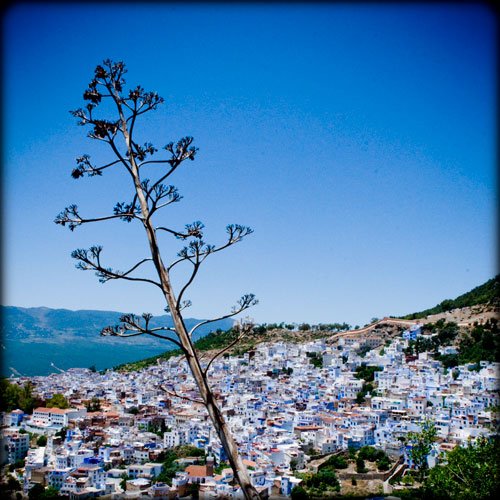 Looking down on Chefchaouen
 Sacks of powdered dye are everywhere
 Stairway to heaven
 Children playing