

Archive
- Behind the Screens 9
- Bright Young Things 16
- Colour Palette 64
- Dress Ups 60
- Fashionisms 25
- Fashionistamatics 107
- Foreign Exchange 13
- From the Pages of… 81
- G.U.I.L.T. 10
- Little Trifles 126
- Lost and Found 89
- Odd Socks 130
- Out of the Album 39
- Red Carpet 3
- Silver Screen Style 33
- Sit Like a Lady! 29
- Spin, Flip, Click 34
- Vintage Rescue 20
- Vintage Style 157
- Wardrobe 101 148
- What I Actually Wore 163
Blown Away
Celebrating the Roaring Twenties in a Special Series

A few years ago I came across an evocative image by Georges Lepape (1887-1971), a French illustrator working for magazines such as Harper’s Bazaar, Vanity Fair and Vogue during the Belle Époque era at the turn of the twentieth century.
He is best remembered for his fashion illustrations of the Art Deco period, and more than a few depict wild atmospheric conditions, of which The Hurricane is one. It is not frightening as the name might imply, but rather suggests the winds of change that blow one in a new direction. One might say that the changes in women’s garments in the early twentieth century did blow in like a hurricane in fact – corsets and hobble skirts gave way to the easy movement of flapper fashions.

While I have never experienced a fierce storm, I do enjoy being out on a windy day – I find it invigorating, and the sound of the wind in the trees exciting. Somehow the sound of the wind always suggests adventure to me, a bit like Vianne, the heroine of Joanne Harris’ book Chocolat, who is beckoned onto the road when the wind blows in a new direction.
Here then nearly a century later is my homage to Lepape’s 1915 picture L’Ouragan. Although his image was made in 1915, I have styled mine à la the 1920s – I deliberately waited until I cut my hair to create this picture. I am wearing a vintage 1970s dress (home-made from what I suspect is curtain material in the style of a flapper dress), a 1950s raspberry striped cloche, and a pair of Noughties ballerina heels.
The backdrop is an image of a storm coming in over Victoria’s Port Phillip Bay, viewed from Rosebud beach that I photographed last year.
The Last Word in Shoelaces

Look at these fancy-schmancy take on gladiator shoes! Aren’t they delightful? I positively languish over them. A beautiful light dove grey, they are made from buttery soft leather, and have a real wooden heel. I love the little triangle cut out of it too – what a great detail. They are like great pieces of sculpture in fact.
And how about those shoelaces, eh? They are the ultimate. In fact, they were a little difficult the first time I stuffed my feet into them (like one of Cinderella’s less attractive sisters) because the laces were pulled too tight, and I couldn’t figure out how to disentangle them! A work colleague, observing my struggles, was amused and remarked that one perhaps needed a science degree just to get into them. I didn’t care about her clever remarks. Not at all. I took them home and a little patience soon sorted those recalcitrant shoelaces out.
… one perhaps needed a science degree just to get into them
These wedges are by British label Finsk – I’d never heard of them before until I bought them online a few months ago from sale site, Ozsale. They were an incredible bargain too, costing one tenth of the retail price (I can’t normally afford to spend $500 on a single pair of shoes).
I’ve been drooling over their latest collection online – check them out. Those shoes are for modern urban warriors, made for STOMPING! Those barbarians better watch out for their toes …

The Berber Weightlifting Champ

I honestly don’t know how some of these tribal ladies don’t collapse under the combined weight of all this fabric and jewellery. The cloak is a dead weight, and I am quite literally carrying a millstone around my neck in the form of a traditional necklace made from stone beads – amongst others. The weight is truly staggering.
I am wearing a number of Berber items that I bought when holidaying in Morocco nearly two years ago, although I am not wearing a technically correct traditional Berber ensemble. Research online was not definitive as there are so many tribal and modern influences to sift through – I became daunted and gave up. This is, after all, only a fanciful evocation of a Berber lady. In general, traditional costumes are made up of layers of coloured woven cloths; pounds and pounds of jewellery, many pieces dripping with silver coins; and henna tattoos. (I probably skimped on the kohl too.)
 The 14th century Merenid Tombs, Fès, June 2011
The most spectacular piece is the cloak. This may look like a carpet, but the Berber merchant I bought it from in Chefchaouen told me that it was a traditional cloak, worn to ward of the desert night’s chill. I am uncertain of its fibre content (so taken with the jingling sequins, I forgot to ask!), but it is woven in subtly complicated stripes and shaggy sections that have been interwoven with silver sequins that are a little tarnished with age. The tarnish only adds to its charm. It is incredibly heavy however. Currently it sits across the bottom of my queen size bed and has become a comforting weight at night – in the winter months at least. It looks decorative though, and it is such a lovely souvenir of my holiday. I saw many of these cloaks used as rugs, some in my room in the Marrakesh riad I stayed in.
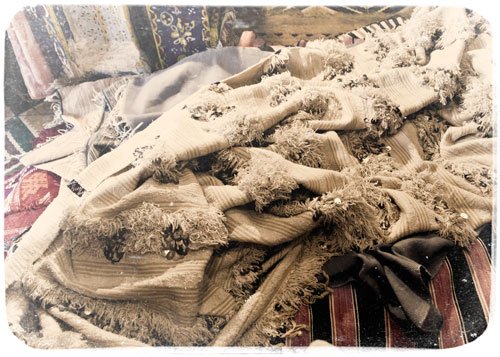 A pile of rugs shown to me, with my favourite on top
 The Chefchaouen Berber carpet seller modelling my antique cloak in his tiny store
 Underneath the cloak I am wearing a vintage Berber kaftan that the seller threw in as a bonus. He let me choose from many that were hanging high on the walls in his shop. I also chose another free item – a traditional belt – that unfortunately you can’t see very well in these pictures. It’s pale green, embroidered in white and pink, and is glued onto a cardboard backing.
The kaftan is cream-coloured brocade woven with metallic silver thread – by the style I am guessing it dates back to the 60s or 70s. It’s quite scratchy to wear, and presumably it would have been worn with a cotton shift of some sort underneath. (As he recommended, I handwashed this in a gentle laundry detergent, and it washed up brighter. The belt I merely sponged, again at the seller’s advice.)
 Most of the jewellery is from Morocco. The chunky necklace is made up from stone, glass and shell beads and is so heavy I could not contemplate wearing it for more than a few minutes. The long coloured beads are all made from glass – one of the necklaces is about 3m end-to-end. All of these pieces came from the souqs in Essaouira. The coin earrings I am wearing are made from replicas of Turkish coins, and were bought in a Melbourne jewellery boutique that specialises in ethnic jewellery from around the world (mostly Arabia and Asia). Although the necklace looks tribal, it was bought from an Australian jewellery chain store, Lovisa.
 I do not know the provenance of the hat. I actually purchased it for 50c from the Australian designer Karen Merkel’s garage sale a few years ago. I was undecided on its purchase as the chains were broken and tangled, and they said I could have it for 50c. “How can you lose?” asked my friend Sapphire, who accompanied me. True. I untangled the mess and managed to figure out its repair.
 The slippers are tooled red leather, bought in Fez. I originally purchased two pairs, one in pumpkin yellow, and this red pair; I wore the yellow as house shoes, and they did wear out rather quickly, so I keep the red pair for special occasions only.
Shopping Notes
If you are planning to travel in Morocco, here are some shopping tips. Obviously you must bargain, and not appear too eager etc – that’s just common sense. I was rather chuffed when my Berber carpet seller opened his eyes wide at my opening gambit and ultimately complimented me on my bargaining skills: “You bargain like a Berber!” (You offer half their asking price to start with, and then go slowly up.)
 I am not sure if he was merely flattering me, but for around €120 I bought the rug you see here and a vintage cloak, and had the kaftan, belt and a few bags of herbs and spices thrown in for good measure (most of which were confiscated by Quarantine at Melbourne airport). The textiles were very heavy though and did cost about $100 to FedEx home. (They arrived home the same day I did, and I believe the package had been opened for inspection by Customs.) I can’t imagine how much a rug like that would cost at home – probably up to $1000. The stone necklace was about $90, and five other necklaces for under $20.
The background image is of the 14th century Merenid Tombs overlooking Fès.
 View of Fez from the Merenid Tombs, June 2011
 The 14th century Merenid Tombs, Fès, June 2011
Cruella’s Kicks
 Two Dalmatians :: Watts // Big Up // No flash
Aren’t these Dalmatian spotted pony hair Mary-Janes simply darling? I squealed with joy when I glimpsed these shoes in a store window in February last year. I didn’t buy them though as I had recently blown my shoe budget, and now I am passionately regretting it. What was I thinking? They would have looked just perfect on my feet. Just call me Cruella …
Devoré du Jour
 What is it about the French language that so prettifies commonplace notions? Devoré fabric refers to velvets that have been dissolved to create transparent patterns. In French, this literally means ‘devoured’. More prosaically, in English this fabric is sometimes referred to as ‘burnout’, which conjures up some rather horrid images.
The process was first created in Europe in the 1920s, and requires velvet that has a blend of cellulose fibre – viscose, cotton, rayon – and a protein-based fibre such as silk. A chemical gel is applied in the desired pattern to the fabric, and the cellulose is dissolved away to leave behind the silk, which appears as a semi-transparent gauze, and thereby creating the pattern.
Devoré was popular during the 1920s unsurprisingly, as it was then invented, and the dresses of the time were so much more inventive with the use of this innovative fabric than the ubiquitous scarves and fringed kimonos of today.
 A 1920s devoré evening frock