

Archive
- Behind the Screens 9
- Bright Young Things 16
- Colour Palette 64
- Dress Ups 60
- Fashionisms 25
- Fashionistamatics 107
- Foreign Exchange 13
- From the Pages of… 81
- G.U.I.L.T. 10
- Little Trifles 126
- Lost and Found 89
- Odd Socks 130
- Out of the Album 39
- Red Carpet 3
- Silver Screen Style 33
- Sit Like a Lady! 29
- Spin, Flip, Click 34
- Vintage Rescue 20
- Vintage Style 157
- Wardrobe 101 148
- What I Actually Wore 163
Bye, Brolly
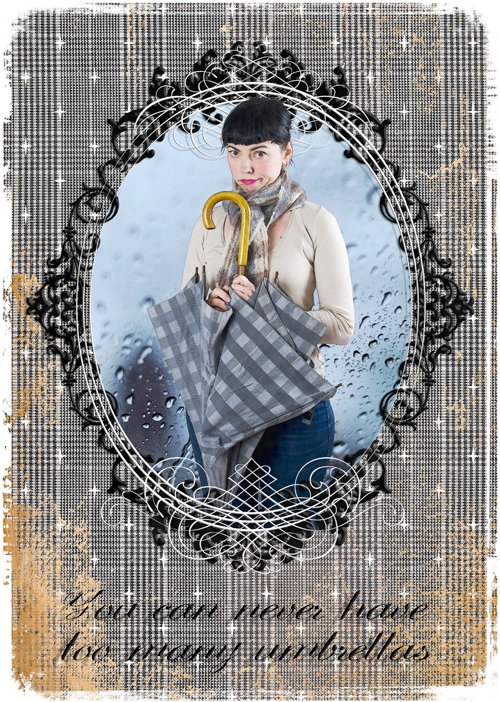 I am so sad! I’ve seen things you wouldn’t have believed. An MNG umbrella blown inside out by fierce wind. I watched another mangled near the Botanical Gardens Gate. All those moments will be lost in time, like tears … in … rain.
Okay, that’s a ribald joke referencing the speech Roy Batty, played by Rutger Hauer, makes at the end of the film Blade Runner. But still, I am devastated my favourite glen plaid umbrella has a broken wing. Once more it was the mischievous wind playing havoc, bending one of the spokes. It was still usable however, and did last for quite some time before the rubbish modern metal snapped in two. But now no more. It is trash.
[Vintage umbrellas] have a pointy steel spike on the end, which is extremely handy for self-defence in an emergency situation.
I remember the day I got it, one boiling hot summer day a few years ago. The brand is Shelta, and they usually retail for $40 or more. I found it in a thrift store for $6 and snapped it up. You can never have too many umbrellas is one of my maxims. My niece on a recent visit demanded to know why I own so many umbrellas. This is why.
I do prefer vintage umbrellas, because they are made from steel and have twice as many spokes as modern umbrellas, which makes them much sturdier in a violent wind. They also usually have a pointy steel spike on the end, which is extremely handy for self-defence in an emergency situation. (It is an actual fact that muggers are more wary of people carrying long umbrellas.) Remember this next time you go vintage shopping and spot an umbrella: Spokes and Spikes.
Photo: This week.
Costume Pearls
 I found these pearl-encrusted half-hoops a little while ago in an op shop but have not worn them yet as they are so extravagant. They are about 1cm wide by 4cm high, and there is nothing at all delicate about their design, which makes me think they must be brash 1980s pieces! Pearls are usually more refined, associated with debutantes and twin sets, but these Eighties numbers are bold and glitzy, which makes me suspect that I will keep these for costume wear only.
They do give me an idea, however, to make some traditional hoops threaded with seed pearls – something like these ones below from Sanctuary Jewellery on Etsy, only more spectacular – by which I mean much bigger!
Photo: Today
 Small pearl hoops from Sanctuary Jewellery on Etsy
The Exotic History of the Pae Jama
Celebrating the Roaring Twenties in a Special Series
 Louche and loose, languid and long, classic wide-legged trousers and lounge pyjamas are closely associated with the relaxed style of the Roaring Twenties, but they did not suddenly just appear out of nowhere, or even – as one of the first women to popularise them for beachwear – out of Coco Chanel’s inventive and pragmatic mind.
Their origins lie in the mysterious and exotic lands in the near east of Europe: India, Iran, Pakistan and Bangladesh, where both men and women wore traditional loose trousers tied at the waist, usually with a belted tunic that extended to the knees. Pyjamas referred only to the trousers, and were tight fitting through the whole leg, or full and loose to the knee, and tighter at the calves and ankles. The word is Hindi, and comes from pae jama, meaning leg clothing. Similar iterations also appeared in the Middle and Far East.
 Pyjamas were worn by Europeans sojourning in these countries, and were brought back home as exotic loungewear. By the 1920s, when Coco Chanel began cavorting on the beach in them, they had adopted the streamlined and loose cut of the Art Deco era, with straight legs and drop-waists.
Louche and loose, languid and long, classic wide-legged trousers and lounge pyjamas are closely associated with the relaxed style of the Roaring Twenties …
 Louise Brooks, 1920s
 Ina Claire, 1925; photograph by Edward Steichen (original link broken)
 Thalia Barbarova, 1925 (original link broken)Pyjamas were considered a fashionable alternative to the teagown – particularly when relaxing at home – and were made from luxurious and printed fabrics; Paul Poiret was an early proponent of these, launching as early as 1911 for both day and evening wear. On the beach their early appearances were quite scandalous and, adopted at first only by the adventurous. By the end of the Twenties, however, they were comme il faut for the average woman.
In fact pajamas were considered elegant beachwear throughout the 1930s, when they began to be cut wider so that they took on the appearance of a skirt. In the 1960s they made another big comeback as palazzo pajamas, and, an enduring style, they still continue to be worn today.
Fashion notes
In my late teens or early twenties, I had my own version of lounge pyjamas made. I purchased a pattern for actual pyjamas and two different fabrics: a paintbrushy floral pattern in autumnal hues of gold, browns and coral on a cream base for the top, and a beautiful goldenrod for the trousers. My sister made them for me, and I wore them everywhere for years (sadly I didn’t keep them), styling them with long pearls, flat Mary-Janes and a classic Louise Brooks bob (my style icon at the time).
In these pictures I am actually wearing modern day pale pink crepe ‘kite’ trousers and a cream silk sleeveless blouse; the pearl beads are vintage 80s.
Photos: March 2014
~
Read more about 1920s pyjama style at Swing Fashionista and Retro Rover (there are some inspiring images there too). There is also a great article at Fashion History: Love to Know that delves deeper into the historical antecedents of the familiar Westernised pyjama.
 Beach pyjamas, 1930s UK; from Swing Fashionista
 Beach pajamas, 1930s UK; from Retro Rover
Robin’s Egg
 Sometime in 2008 or 9 I lost a favourite turquoise ring, the stone becoming dislodged from its sterling silver setting and falling out in the street one evening as I walked home from a night out with friends. I was devastated, because turquoise – or robin’s egg blue – is my favourite colour, and that stone was a perfect blue with no intrusions. It was actually as big as a robin’s egg too, although it was flattish; it was even tear-drop-shaped. (Sadly I never photographed it.)
In 2011 I bought another turquoise ring in Barcelona, which I do like very much too. It is quite a different design, being stone all the way round (see it here). However, a couple of weeks ago I found a ring in a thrift store that is almost an exact replica of the original! I couldn’t believe it. Only the shape is different, being more oval, and it has a few brown veins of limonite (iron ore) threading through it. But it is comparable in size to the original, being 3cm x 2.5cm (the original was slightly longer). Extraordinarily, it was priced at only $10 – I paid a lot more for the original ring! Talk about luck, even if it took eight years to strike.
a couple of weeks ago I found a ring … that is almost an exact replica of the original!
The name ‘turquoise’ means ‘Turkish stone’, and comes from the French pierre turquoise, because the trade routes that brought this sky-blue stone to Europe from Asia passed through Turkey, and Italian merchants often purchased it in Turkish bazaars. It is probably the oldest stone in mankind’s history: turquoise beads from Iran have been dated back to 5000 BC; the Egyptians were mining it since 3200 BC; and of course native Americans have been mining and fashioning it for almost a thousand years too.
It is a beautiful stone with an extraordinary pedigree, and now it will adorn my hand once more. Just like the original ring, the plain setting lets this opaque stone really shine.
Photo: Today
Almost Boho
 While I have never identified with boho style, I do have quite eclectic taste, which includes embraces of boho’s defining characteristics: patterns, embroidery, ethnic costume, colourful beads, etc.
I have been attracted to embroidery for a long time, partly because of my Slavic background, and had always wanted to own a traditional embroidered blouse. (I only wish my grandmother had taught me to embroider before she died, but that occurred long before I was even interested in needlework.)
 I came across this blouse in a vintage store, though it was a more modern piece, probably originally from an inexpensive high street store. Made from cotton, with a crochet trim, and colourful floral embroidery, it was cut in a smock style, and had three-quarter sleeves. Of course I wanted to wear it immediately (despite the chilly winter) so I slipped it over a black wool turtleneck. The combination has a hippy, almost boho flavour.
But I only wore the blouse once or twice more after this occasion in June, 2010 – because I never felt quite right in it. It was just too boho for me! The blouse eventually was donated to charity; the beloved grey cords died; and I don’t recall what became of the black turtleneck. The coat is the only survivor of subsequent wardrobe culls.
Amusingly, I currently have an even nicer embroidered peasant blouse, this one a warm yellow-cream, and I have not worn it once! It’s too pretty to toss though.
 In My Dreams shrugBut for a truly beautiful, designer embroidered garment I know where I would go: Nevenka, a label designed by Croatian-Australian, Rosemary Masic. She is inspired by the same traditional embroidery, but her stunning designs are modern and exquisitely cut from lovely fabric – the lace alone is jaw-dropping, and distinctly Eastern-European rather than the French or Belgian style lace such as Chantilly or Valenciennes (typical bridal fabrics) that we might be more familiar with. Being half-Croatian myself, these fabrics really resonate with me.
Luxe though these garments are, they are certainly bohemian in style.
 Fierce Warrior skirt
 Live in the Moment dress
 Water Runs Deep dress