


Archive
- Behind the Screens 9
- Bright Young Things 16
- Colour Palette 64
- Dress Ups 60
- Fashionisms 25
- Fashionistamatics 107
- Foreign Exchange 13
- From the Pages of… 81
- G.U.I.L.T. 10
- Little Trifles 126
- Lost and Found 89
- Odd Socks 130
- Out of the Album 39
- Red Carpet 3
- Silver Screen Style 33
- Sit Like a Lady! 29
- Spin, Flip, Click 34
- Vintage Rescue 20
- Vintage Style 157
- Wardrobe 101 148
- What I Actually Wore 163
The Colour of Happiness
 Vintage 70s cotton dress, bought on Etsy; photo: March 2014
When I think of the colour yellow I immediately think of sunshine, summer, and happiness. I also think of taxi cabs, and the bright yellow raincoats of childhood. There are also bananas, daffodils, lemons, butter and … lemon meringue pie! Yum!
Yet while the golden hue is associated with positive notions such as amusement, gentleness and spontaneity, it is also symbolic of ‘duplicity, envy, jealousy, avarice, and, in the US, cowardice’. In a survey, only six percent of respondents in Europe and America named it as their favorite color, compared with 45 percent for blue, 15 percent for green, 12 percent for red, and 10 percent for black. [Wikipedia; Inspector Insight]
 Golden Wattle (Acacia pycnantha), Australia's national flower blooms in spring
 What's more sunshine yellow than the sunset on the Sunshine Coast in Queensland?
 A vintage yellow cab
 Lemmmmon mmmmeringe pie!
The Origin of a Bad Rep
Obviously there is there are certain common phrases incorporating the word ‘yellow’ that have negative connotations, such as ‘yellow belly’, ‘yellow fever’ and ‘yellow journalism’, but everywhere I looked researching this topic people talked about jealousy, duplicity etc, and they were only parroting other sources. It took me a long time to track down the origin of this colour defamation.
I recalled an old printed copy of the book The Language of Flowers listed jealousy and guilt as the meaning of yellow roses, but their website now states joy and friendship. Another source, Lily’s Rose Garden has a very different tale, which is probably the source of the negative connotations:
‘According to the legend, the Prophet Mohammed, while away fighting a war, was tormented by the idea that his wife, Aisha, was being unfaithful. He asked the archangel Gabriel for help. Gabriel suggested that when he returned home Mohammed should ask his wife to drop whatever she was carrying into the water as a test. If she was faithful, it would stay the same colour and prove her unconditional love. Mohammed finally returned from his battle and Aisha rushed to greet him, carrying a huge bouquet of red roses. She was surprised when he commanded her to drop them into the river, but obeyed and the roses turned saffron yellow. Eventually, Mohammed forgave his favorite wife but, for some, the yellow rose remains a symbol of infidelity.’
 Could these beautiful yellow roses actually imply 'you are not worthy'?!Lily’s Rose Garden goes on to suggest the new association with friendship has simply been made up by rose growers to promote sales. I say, all power to them. I think yellow roses are beautiful, and much more original than pedestrian red. If anyone wants to buy some for me I will gladly accept them and never mind such connotations, as ‘I am not worthy’!
I think yellow roses are beautiful, and much more original than pedestrian red.
 Cotton cable knit; photo: July 2016
Child of Heaven
In China, however, yellow is a very popular colour and represents happiness, glory, wisdom, harmony and culture. Yes! There are five directions of the compass in Chinese tradition; north, south, east, west, and the middle, each with a symbolic color. Yellow signifies the middle. China is called the Middle Kingdom; the palace of the Emperor was considered to be in the exact center of the world.
 Yellow has strong historical and cultural associations in China, where it is the color of happiness, glory, and wisdom. This 1400 year old gingko tree turns the ground into a yellow ocean come mid-November. The ancient tree grows next to the Gu Guanyin Buddhist Temple in the Zhongnan Mountains and is a perfect celebration of autumn.The emperor of China is considered a ‘child of heaven’, and the legendary first emperor of China was called the Yellow Emperor. The last emperor of China, Puyi (1906–67), described in his memoirs how every object which surrounded him as a child was yellow. “It made me understand from my most tender age that I was of a unique essence, and it instilled in me the consciousness of my ‘celestial nature’ which made me different from every other human.”
 Wool and angora cable knit; photo: July 2016
On the Palette
Joseph William Turner is historically one of few artists who loved yellow and used it extensively and predominantly in his paintings. He loved it so much British critics mocked him for it, writing that his images were ‘afflicted with jaundice’, and that the artist may have a vision disorder.
 Sunflowers, Vincent Van Gogh 1888Another artist who favoured yellow, Vincent Van Gogh, loved the sunshine and wrote to his sister, “Now we are having beautiful warm, windless weather that is very beneficial to me. The sun, a light that for lack of a better word I can only call yellow, bright sulphur yellow, pale lemon gold. How beautiful yellow is!”
Paul Gauguin, a friend and artistic companion attests: “Oh yes! He loved yellow, did good Vincent, the painter from Holland, gleams of sunlight warming his soul, which detested fog.”
Before them, there were artists such as Rembrandt, Vermeer, Bruegel did use it extensively, but more in the case of painting yellow subjects. Creating paintings in which a particular colour is significant, or even the subject, seems to be a modern phenomenon in Western art (ie, before the Post Impressionists).
 Sunshine yellow gown by Jason Wu
On Your Back
Yellow in every shade was huge on the Spring/Summer 2016 runways, where it appeared on the catwalks of Stella McCartney, Christopher Kane, Roksanda and others, and in the Resort collections of this year; Beyoncé wore it, accessorised with a baseball bat. (Visit this Pinterest board for some inspiration.)
In my personal experience, I have heard many people exclaim with fright or horror at the notion of wearing yellow, and I can only conclude it is too eye-catching for them. Some may say ‘oh, yellow doesn’t suit me’, but they are forgetting that there are many shades – just as one shade of green may not suit one, a different hue will; it all depends on one’s complexion. I’ve never heard anyone say, ‘black doesn’t suit me’, but in truth it can make some skin tones look sallow, just as pure white can. Shade (hue) and tone (warmth or coolness) are crucial. You know when a colour suits you: it makes you look radiant.
My conclusion is this: if you want to look like a goddess, WEAR YELLOW.
~
Fashion Notes
The golden yellow cotton dress I am wearing in the first picture is vintage 70s, which I found late one evening trawling Etsy – yellow dresses are literally one of my regular searches online – and I snapped it up immediately for a song. Amazingly, I have found another one on Etsy which is from the same range, available still on publish date, although it is unfortunately much more expensive. My dress is as large and loose as the one in the picture, but I would be swamped if I wore it without a belt. It is certainly very swingy and fun to wear, and I always am given compliments when I have it on.
 This dress is listed as XS/S/M; its 12" yoke is much smaller than my 16" yoke.
My two taxi-yellow cable-knit jumpers are virtually identical, except that one is a winter weight in wool and angora, which I bought on eBay from America and had it shipped here at great expense, and the other is cotton, which I found in an op shop right here in town for around $6. Now I can wear the colour of happiness summer and winter.
Here are a couple of other lovely yellow vintage items, currently available on Etsy.
 A super fun 60s cotton skirt
 A vintage 50s velvet dress and fitted jacket
The Good Little Hausfrau and The Evils of Bleach

On the weekend I was being a good little hausfrau and doing all my tedious chores on Saturday. For this special event, I pulled out a fresh tee I hadn’t worn for a while – ever since I assiduously and labouriously removed some ink or paint stains (if memory serves me) from the last time I wore this t-shirt without donning an artist’s smock over the top.
You’d think that would have learned me, but no.
 I did not don an apron, but went merrily on my way with my chores. While cleaning the bathroom, energetically employing a bottle of Domestos – a brand of bleach – and generously swirling it around the enamel sink, I must have caught a stray drop with my tee (see depressing detail picture on left). I didn’t spot it until much later, when it was far too late to attempt to soak it out.
Dear Snapettes, it was like one of those ‘command-Z’ life moments, when all you want to do is hit the undo button. But alas, it is impossible. The top is clearly doomed to only and forever be a housework tee.
The moral of this sad tale is of course, wear a housecoat, or even better – pay some cleaners to do the dirty work.
Photos: Yesterday

Wearing the Trousers
 Super for the summer: lounging pyjamas in a pretty print with a matching jacket, 1928; a woman wearing a leaf-pattern trouser suit and broad-brimmed sun hatToday a good part of the world’s population is celebrating International Women’s Day.
Not only do we laud the remarkable women of history who achieved great and extraordinary things as human beings, but also as women in the face of incredible odds and sometimes horrific circumstances. We are also celebrating the quiet achievers: our mothers, grandmothers, daughters, sisters, aunts, nieces (and every other conceivable female relative, pardon the pun) and of course our girlfriends. We couldn’t have done anything without the women who came before us.
One thing I can’t help but think about women’s history in the world is our liberation from strictures of dress – literally. That may seem trivial at first, but being rid of societal strictures about what we wear is a huge gift.
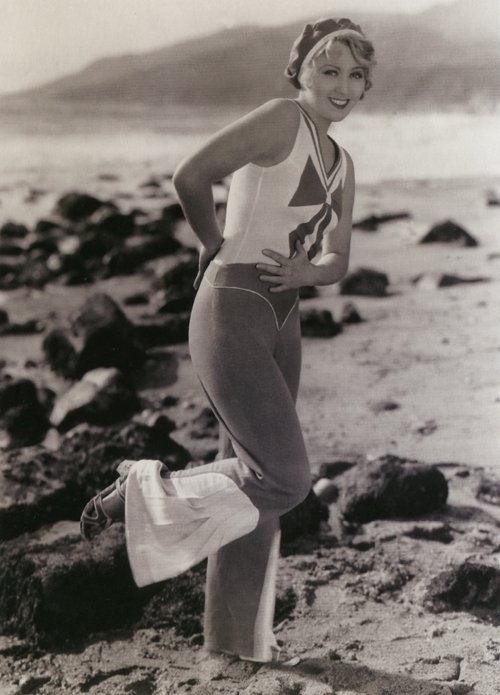 Blonde bombshell: a curvy catsuit with a pleated inset at the trouser bottoms, 1929; American actress, Joan Blondell, a whacky, wise-cracking Hollywood starletTrousers were first adopted in Western Europe the period known as Late Antiquity (the transition period between Classical Antiquity and the Middle Ages), but they were mostly worn by men. It was not until the twentieth century that wearing the pants first became acceptable for women, by way of imported pantaloons from the Near East, to pyjamas at home (in place of the traditional teagown), to pyjamas on the beach in the 1920s and 30s (read about the exotic origin of the pyjama here). Of course the First World War had a lot to do with the emancipation of the Flappers, and the adoption of trousers beyond work wear for the war effort.
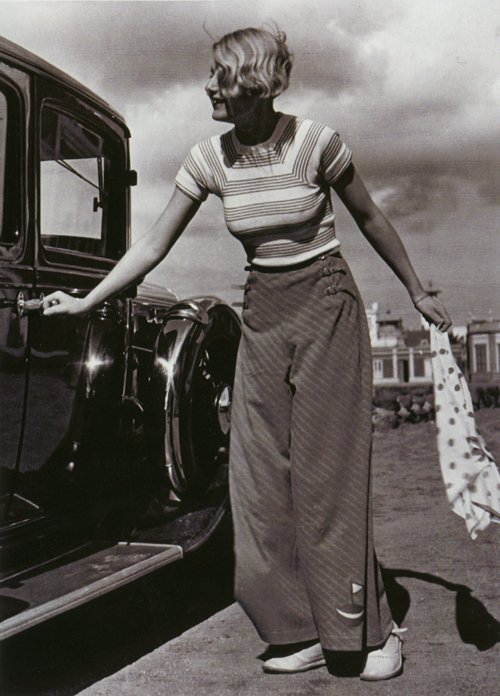 Beach babe: baggy bell-bottoms, a tight striped top, a spotted scarf and plimsolls, 1932; a girl with a bobbed haircut, dressed for a day out on the boardwalk
Perhaps in another century or two it will be de rigueur for men to be wearing dresses again.
Shockingly, there are still parts of the world where it is a criminal offence for a woman to wear trousers. I think everyone has forgotten that once upon a time everyone wore robes, togas, chitons, tunics, kilts whatever-you-may-call-’em. Perhaps in another century or two it will be de rigueur for men to be wearing dresses again.
Here are some glorious vintage pictures of women wearing trousers, from the 20s to the 70s – so many awesome styles! Enjoy your day, women of the world.
Photos from: Style Book – Fashionable Inspirations, by Elizabeth Walker, Flammarion 2011
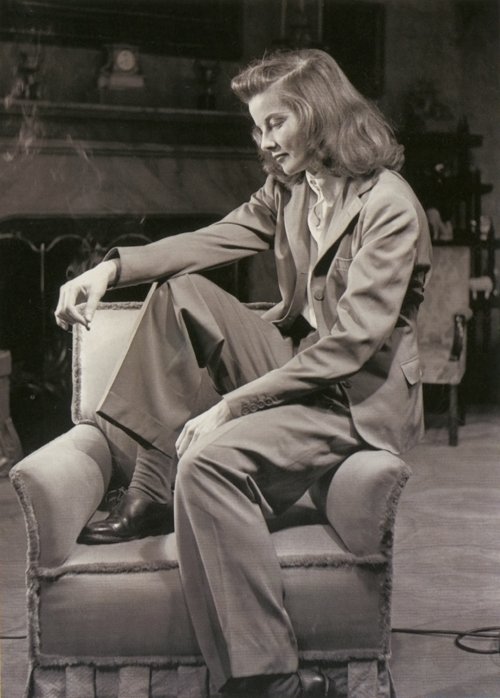 Stellar and smouldering: in a Spencer Tracy suit, complete with brogues, 1938; American actress, Katharine Hepburn sitting on the arm of a chair smoking
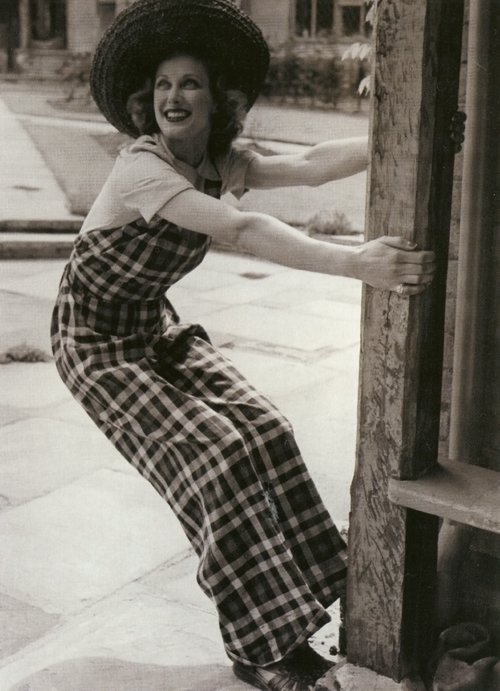 Land-girl looks: dungarees in bold checks, more Chelsea than cabbages, 1941; clothes for A Coupon Summer
 World War wear: crisp in white cotton with a classic rolled hairdo, 1943; a woman wearing coveralls examines designs on a drafting table
 Shock horror: collegiates in trousers, men’s shirts, bobby socks and even loafers, 1947; American students in Heidelberg, Germany, astound the local ladies
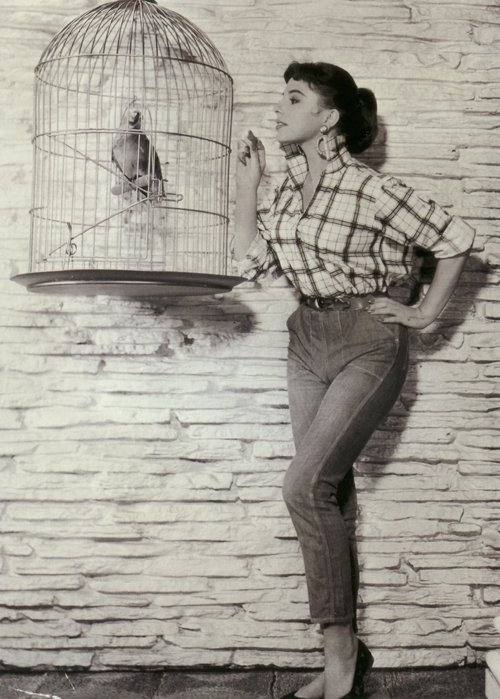 Sexy siren or beautiful beatnik, a cinched-in waist and huge hoop earrings, 1955; British actress Joan Collins feeding a parrot in a big birdcage
 Boyish and yet beautiful, a sailor sweater with jeans, topped off with a pixie haircut, 1965; a portrait of American actress Jean Seberg sitting cross-legged on a stool
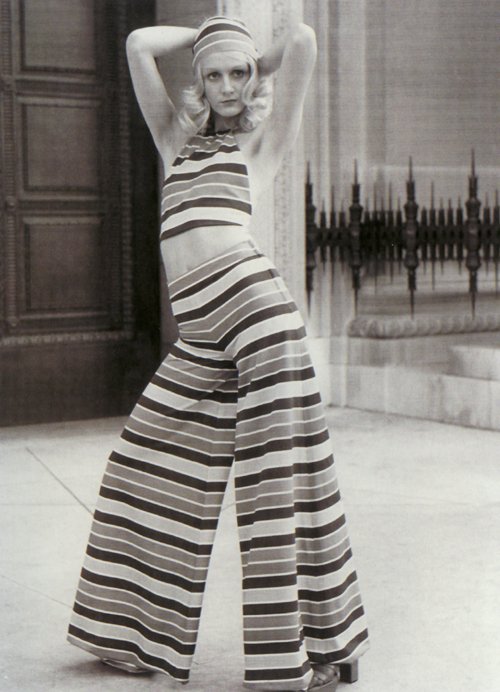 Matching moments: a cropped top, flared loons, topped off with a little beanie hat, 1971; a model wearing ‘Lollipop’, from the Mary Quant spring collection, London
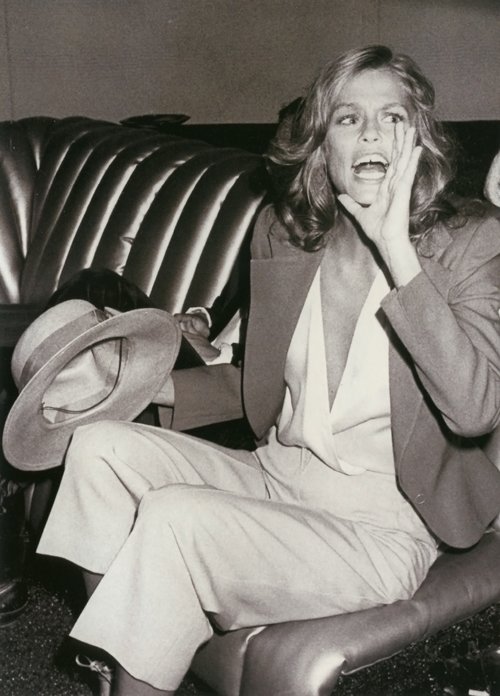 Just a gigolo: clubbing in a classic jacket and trousers with a fedora in hand, 1978; American model and occasional actress, Lauren Hutton at Studio 54, USA
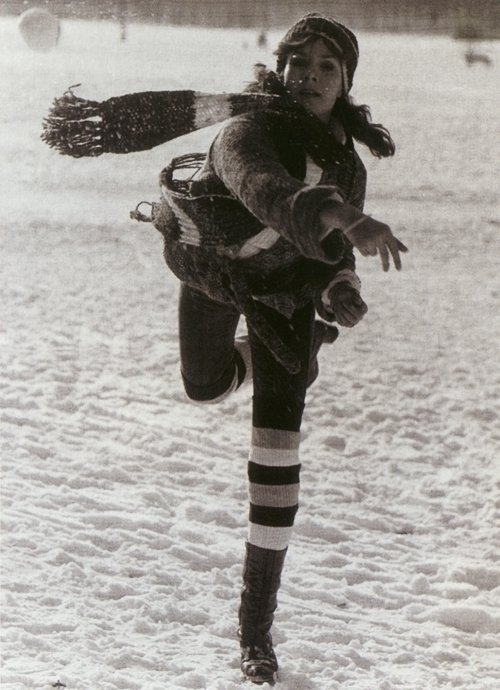 Fighting fashion: snowballing and stripes, and very Flashdance legwarmers, 1982; knitting from head to toe protect a girl from the wintry weather
Hot Today, Mild Later
 I suddenly realised I’ve been distracted by the still-summery weather and the traumas of html, and have forgotten to give a proper welcome to autumn!
Last year I went on a tour of op shops in my sister’s neighbourhood, and I managed to unearth many awesome clothes and accessories, quite a few of which have already featured on this style journal – a blue 70s cardigan, a pink plaid scarf, and a sculptured wooden bangle.
This leather belt is I think from the 1980s. I liken to bark or autumnal leaves. It was actually picked up by my sister first: she handed it to me, but it was only after I tried it on that she suddenly said, “Why did I give it to you? I like it!” “Too late!” I replied promptly, and bought it for $5. (I will add, I had seen it much earlier when we first arrived in the shop, but had been distracted by a magnificent 70s silk chiffon dress displayed on a mannequin – but that’s a story for another time.)
In any case, finally: welcome autumn.
Photo: August 2016
Grecian Draping
 Two notions come to my mind on hearing the word ‘goddess’: Ancient Greek deities, and screen sirens of the Hollywood’s golden era. Both are evocative of unearthly or extraordinary beauty, creatures with the power to utterly charm and bewitch ordinary mortals.
Thus the ‘goddess gown’ is associated with the garments of the Ancient Greeks – chiton, peplos, and tunic – as well as the sweeping 1930s gowns worn by the likes of Jean Harlow, Carole Lombard, Norma Shearer, and Rita Hayworth.
Greek clothing was very simply cut. The loose-fitting and free-flowing chiton, worn by both men and women, was basically two rectangles of fabric joined at the shoulders and sides. Lengths and additional shapes – such as circles or triangles – varied, while different looks were achieved through arrangements that created elegant draping. The most common fabrics were linen and wool. Additional decoration came in the form of pleating, embroidery, belts and jewellery. The result was a style of dress that both revealed and concealed the human figure.
 Jean Harlow, in a gown by costumier Adrian; designed for the film Dinner at EightBy contrast, the goddess gowns of the stars of Hollywood’s golden years were slender and form fitting, especially in the bodice, and were often backless. Cuts were more sophisticated; linen and wool had been replaced with silk and lamé. But they still had the yards of fabric, the columnar fluidity, complex pleating, and asymmetric draping in common with the Ancient Greeks who inspired them. Where before Paris had lead fashion, now Hollywood began to take over in the popular imagination; many of these fantasy gowns were designed by the famous costumier, Adrian.
In short, these were sexier gowns really meant for goddesses, not the hoi polloi.
In short, these were sexier gowns really meant for goddesses, not the hoi polloi. It’s no wonder these silver screen stars were named for the sirens of Greek mythology, who lured sailors to death with their seductive singing.
 Madame Grès (1903–1993) and Madeleine Vionnet (1876–1975) were both French fashion designers who were proponents of Grecian dress.
Grès’s minimalist gowns were wrapped and draped in the most masterful way – that she was trained in sculpture is obvious when one looks at her designs. One of her gowns could take up to 300 hours to create, with pleats sewn by hand, and the cloth draped so that the body shaped the dress – far longer than the Ancient Greeks one imagines.
 Gown by Madame Grès, 1940; ph George Platt Lynes
 Gown by Madeleine Vionnet, 1933; ph George Hoyningen-HueneVionnet is known for popularising, if not inventing, the bias cut to create sleek and flattering dresses that skimmed the body languidly. Her gowns were soft, floating freely, and did not distort the natural curves of a woman’s body. She used more unusual fabrics for women’s clothing in the 20s and 30s, such as crepe de chine, gabardine and satin, and always ordered two yards extra for each dress to accommodate the draping.
Both Grès and Vionnet have continued to inspire fashion designers to the present day.
Today, we still see the classic goddess gown on our screen stars, but it is also a favourite style of wedding dress (one of the few occasions when ordinary mortals don floor-length gowns), as an alternative to the classic 50s-style princess gown of strapless-boned-bodice-and-big-skirt ilk. … And above all other days, one should feel like a goddess on one’s own wedding day.
Key Characteristics
• columnar, bias-but
• fluid draping
• pleating
• asymmetry
• floor-length
Fashion Note
My very simple grey jersey goddess gown is by English label Karen Millen, and features characteristic asymmetry, draping, and an interesting cut to the back.
Photos: January 2014
Scroll down for more images. Links have been provided where available.
 Bette Davis
 Carole Lombard
 Gowns by Madeleine Vionnet
 Gown by Madame Grès
 Norma Shearer
 Rita Hayworth