

Archive
- Behind the Screens 9
- Bright Young Things 16
- Colour Palette 64
- Dress Ups 60
- Fashionisms 25
- Fashionistamatics 107
- Foreign Exchange 13
- From the Pages of… 81
- G.U.I.L.T. 10
- Little Trifles 126
- Lost and Found 89
- Odd Socks 130
- Out of the Album 39
- Red Carpet 3
- Silver Screen Style 33
- Sit Like a Lady! 29
- Spin, Flip, Click 34
- Vintage Rescue 20
- Vintage Style 157
- Wardrobe 101 148
- What I Actually Wore 163
Stocking Stuff
 Recently I found a stack of 1960s vintage stockings in a thrift store, which was a fun and thrilling find that had more to do with the packaging than the actual contents. This is partly because I am a graphic designer, and mostly because I can’t be bothered with donning garters on a regular basis, especially as I am always dressing in a hurry. In my early 20s I often did wear stockings, and cursed when I had failed to button garters properly. There is nothing like the horror and mortification of a stocking coming down at the most inopportune moment due to failed garters!

Vintage Stockings
There is a set of three pairs of nylon stockings by Bouquet, in a beige skin tone, size 8½; one packet had already been opened and the contents examined – whether by the original owner or someone else I don’t know, but they haven’t been worn.
 The wonderful second package – illustrated with a poodle! – contains Kolotex Clings stockings, in the colour ‘Flame’, size 8½–9. If the poodle on the box is not enough to delight you, the interior packaging is priceless. It includes instructions for how to put pantyhose on (I would add to them: file your nails, or else wear cotton gloves when pulling on fine hosiery), and also a promotional pamphlet disguised as a fashion quiz, the cover design of which is in an early psychedelic style. This pamphlet is full of everything you wanted to know about Trikolon, a 2-way nylon: ‘so fine a spider couldn’t spin it’.
While Kolotex was already producing full pantyhose at this point, the owner of these clearly had not yet made the shift – or perhaps they had in fact, which is why the contents of these packages remained unworn relics.

 Click for larger version
A Bit of History
Nylon was introduced in 1939 by chemical company DuPont, but WWII interrupted the manufacture of stockings, leading to global shortages and a black market that did not abate until the end of the war. Even after production was reinstated, DuPont could not keep up with the immediate demand, and that lead to nylon riots in America!
Pantyhose were introduced in 1959 and quickly became popular, eventually superseding stockings in sales, especially with the Sixties craze for minidresses. It was not until 1987 that sales declined – though only a little – with the newly invented stay-up stockings. These are my favourite: there is no bother of pulling them up and down whenever one goes to the bathroom, and there is no tiresome fiddling with garters.
The copy in the Kolotex fashion quiz is quite entertaining; click through to the gallery to see all twelve pages.

Photos: March 2017
Extra Sugar
 A few years ago, my occasional collaborator Sapphire and I transformed ourselves into anime girls to create a little humorous cartoon sequence. It was based on the premise that these typically skimpily-clad girls were drawn by male artists, and were TIRED OF IT. They’d had jack of glorified scanties and wanted to wear designer clothes. And they were prepared to fight for them!
Long-time readers of SNAP will not wonder where our costumes came from: out of my closet, which encompasses a multitude of wigs, accessories and sundry oddments as well as a vast assortment of vintage and contemporary clothes – almost anything you could imagine. A 1950s opera cloak? Tick! An 1850s velvet skating coat? Tick! A Victorian woman’s evening top hat? Edwardian underclothes? A pair of over-the-knee leather boots? A long, curly-haired pink wig? Tick, tick, tick! (Those who know my tiny apartment often exclaim, “Where do you keep it all?!”)
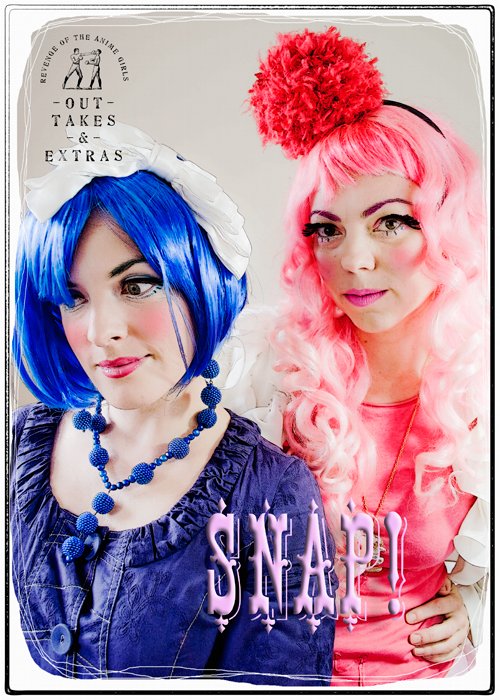 Once we’d worked out what our costumes were going to be, the really fun part was putting on our makeup. Sapphire had cleverly done her research and found some YouTube tutorials on transforming our boring human eyes into enormous anime eyes. I supplied an enormous quantity of makeup for the purpose (Sapphire enquiring, “Do you have white eyeliner?” “Yes!” “Liquid eyeliner?” “Yes!” “False eyelashes?” “Yes! I have everything!”). The only thing Sapphire had to bring was a pair of shoes, since she’s a size smaller than me.
Every time I put on false eyelashes for a special event – these ones are black feathers – I think they are such fun that I should wear them every day. Whenever I do wear them for several hours, I am so happy to rip them off as soon as I come home however. Everyone knows the pleasure of wriggling toes upon removing painful heels, but there is the same bliss in removing the weight of sticky curtains from one’s eyelids.
 Click for larger versionWhen I opened the folder on my computer I laughed when I saw these out-takes and extras – how awesome we looked! We also took some Hipstamatic photos behind the scenes of the photoshoot: there is even one of me hurriedly repairing a pair of handmade earrings for Sapphire to wear that match her necklace. The red pom-pom headband I am wearing I also made. One of the other amusing vintage garments are the 1960s lace-trimmed petti-pants Sapphire wears under her blue dress. All the clothes we are wearing are secondhand items I sourced from various places, except for the over-the-knee socks, both of which were new, and the pink nylon tutu I have on.
You can see the original story Revenge of the Anime Girls here – I enlisted the help of a bemused male work colleague to do the hand modelling, and he was very forbearing about being kicked by two miniature women. Looking at all these behind-the-scenes photos reminds me how much fun we had. It might be time to book another date with Sapphire!
Photos: March 2013
What I Actually Wore #0131
 Serial #: 0131
Date: 03/07/2013
Weather: 16°C / 61°F
Time Allowed: 10 minutes
On a chilly day I decide wool is necessary. A new Anthropologie dress is the easiest choice; I had recently purchased it secondhand on eBay. I had picked it out because of the geometric pattern, which was very Art Deco, even if the minidress had a more modern shape. The knit is quite thick and sturdy, and surprisingly warm. I like the belt which is made in the same fabric too. Matching belts are one thing that so often go astray from their dresses in op shops – it’s maddening! Contrasting ones sometimes never look quite right.
 Underneath the dress I wear what I always thought of as my black Guinevere knit, because it had a medieval look with the little puffed shoulders and fitted sleeves. I purchased this Max Studio top in Hong Kong in, I think, 2006, so it had been in my closet for a decade before being culled at the end of last winter. The stockings are also wool for warmth, and my sparkly red Dorothy heels add a splash of colour.
 Over this outfit I wore my beloved but fragile vintage 70s Zhivago coat, suede with rabbit fur trim, a vintage velvet and fur-trimmed cloche cap, and carried my black patent vintage 60s/70s handbag. It’s quite a vintage look, but once the coat is off this is a fairly simple outfit, which I like. My hair looks freshly-bobbed too. As it’s growing out now from my current pixie cut, I have been wondering whether to get a bob again, but I am a long way off from this length still.
Photos: July 2013
Items:
Dress: Alice + Olivia for Anthropologie
Top: Max Studio
Coat: Stephen Dattner, vintage
Stockings: Columbine
Hat: vintage
Watch: Kenneth Cole
Jewellery: souvenirs (bangle, ring), handmade (earrings)
Bag: vintage
Shoes: Wittner
The Coat of Many Winters
 Today I give homage to a very favourite old coat that I recently gave up to the hope shop. (That’s what I call op, or thrift, shops, and the designation is particularly poignant in this instance.) I bought this coat many years ago from Melbourne designer Obüs; it was my first ‘grown-up’ coat purchase. It was made from herringbone tweed, and featured a double-zipped front, the zips of which could go two ways. The sleeves also had zips up to the elbows, for extra ventilation. When I first saw it, I loved the modern minimalist design combined with the classic camel-coloured tweed.
I wore this coat for many winters, and even after the pockets tore a little at the sides from careless hand-stuffing, I continued to wear it. (Of course, I did not wear it all the time, as I am a coat aficionado from way back and alternated it with many others.)
I look at this photo and feel a little pang in my fashion heart.
It was only last winter that I noticed that one of the shoulders had become so worn in two places from rubbing caused by my shoulder bags, that the fabric had actually shredded into fragments of warp and weft. It was really ready for the rag-bag, but the coat held such sentimental value for me that I considered trying to have it repaired, perhaps by inserting leather shoulder patches. But there were also other signs of wear, and the torn pockets. I decided, in view of how many coats I actually own, and how little space I had for them all, that it was not worth the investment of a difficult repair, or even merely keeping it as a sentimental piece.
In a ruthless moment of wardrobe culling, I put it in a bag destined for the charity store (in case someone had some use for it, damaged as it was) and steeled myself to drop it at the Salvo’s depot. And I did it. But first, I photographed it. Now, I look at this photo and feel a little pang in my fashion heart. It gave me good love for well over ten years – I hope it comes to a good end.
Photo: January 2017
Easter Parade
 This Easter Sunday evening I have a veritable parade of vintage 1940s hats to show off. (Is that the collective noun for hats? If not, it should be! … I just checked Answers.com and it informed me that it is either a millinery of hats or a fascination of hats. The former is boring, and the latter very cute; I still like parade however.)
Again, all of these hats are recent acquisitions, bought in op shops (thrift stores) over the past spring and summer for quite piddling sums – not as piddling as my straw hats, but almost, which I consider quite a feat here in Australia. Genuine vintage hats are not easy to come by, and those available in boutiques or fairs are often $80+, with 20s–30s hats very much more. These four hats ranged between $10–20.
First up is a black braided wool felt beret. It features a circular ribbing effect created by the braid that has been stitched together to form the hat foundation. It is quite stiff, and definitely needs the attached satin band to keep it on the head (fitting around the head, on top of the hair); this is finished with a satin bow at the back, just above the nape. It has a quite jaunty look! There is only the remnants of a label inside, unfortunately.
 There are myriad styles of 1940s hats. While some have definite names (berets, fedoras, cartwheels etc), others do not have distinctive appellations. This high-crowned red velvet hat is somewhat reminiscent of a turban, or perhaps it has some antecedents in historical military hats. It could be described as a toque, which is simply a hat without a brim. It has a smooth curve to the back, and two little red bows above the ears. The colour is certainly fantastically vivid, and the fabric plush. The label states it is a Phyl Clarkson Exclusive Model, from Rondel’s of London, New York, Sydney.
 This pink wool felt hat is a platter with a twist (literally): it is gathered up at the back with a little bow as though the brim has been twisted, creating the effect of flower petals. It is a glorious shade of deep rose, and the label says Newhaus, Herta Maria Melbourne.
 I am not sure quite how to describe the last hat, a navy wool Parisian model, by Georgette. It has a bow of matching wool piping and is trimmed with an ostrich feather where the brim has been turned up. Worn at a tilt it puts me in mind of nineteenth century riding hats – women often wore feminine versions of men’s hats such as bicorns, tricorns and toppers. This hat has only one side turned up however. Perusing various resources on 40s hats has not been of much assistance either – even contemporary fashion journals unhelpfully described some hats simply as ‘hats’. (Vintage Dancer has a great article, but even they stop at twenty types.)
Hats were one item that were not rationed during the war years, so milliners were really able to go to town with materials, trims and styling – only their imaginations were the limit; there are some really extraordinary shapes out there. I feel lucky enough to own just a few crazy 40s hats. I am looking forward to winter to wear these at last!
Photos: August 2016