

Archive
- Behind the Screens 9
- Bright Young Things 16
- Colour Palette 64
- Dress Ups 60
- Fashionisms 25
- Fashionistamatics 107
- Foreign Exchange 13
- From the Pages of… 81
- G.U.I.L.T. 10
- Little Trifles 126
- Lost and Found 89
- Odd Socks 130
- Out of the Album 39
- Red Carpet 3
- Silver Screen Style 33
- Sit Like a Lady! 29
- Spin, Flip, Click 34
- Vintage Rescue 20
- Vintage Style 157
- Wardrobe 101 148
- What I Actually Wore 163
May the Fourth Be With You

On this auspicious occasion who could go past a homage from one princess to another? This is actually a throwback to a photoshoot I did more than six years ago, when I attempted to recreate Princess Leia’s iconic buns. My hair was very long then, and my home hairstyling was a complete failure – I found it harder than expected to twist my hair into buns of the requisite size! This time round I’ve used an outtake from the shoot, and inflated my floppy buns with the aid of Photoshop. Vale Carrie Fisher, and …

Photo: January 2011
How to Beret
 Last weekend a friend brought up the subject of berets, and what was the right way of wearing them. “Right way?” I exclaimed. “There isn’t one right way – there’s lots of ways of wearing them!” I was wearing one right at that moment, angled on one side. It also depends on the style of beret, I told her.
The beret still bears today a strong whiff of bohemians and beatniks, intellectuals and pipe-smoking filmmakers.
I own quite a lot of different berets made from winter weight wools, and lighter summer versions of cotton and rayon. Apart from the classic little wool beret we are all familiar with (I prefer felted wool to knits or crochet, which is too bohemian for me and smacks of Sienna Miller and her ilk), there are the huge platter versions from the 1940s, and inflated types from the 50s and 60s.
History
The beret has a very long history – similar hats were worn since the Bronze Age across Northern Europe and even as far south as Italy and Crete where they were worn by the Romans. Scottish types feature a pompom on top. It has been adopted as a military hat, as sportswear, and more latterly as a fashion item. The beret still bears today a strong whiff of bohemians and beatniks, intellectuals and pipe-smoking filmmakers.

A French Icon
A beret worn with a striped tee has become the stereotypical depiction of a Frenchman – this image actually originated with the ‘Onion Johnnies’. They were Breton farmers and labourers on bicycles who sold pink onions door to door in Great Britain in the first half of the twentieth century. Onion Johnnies were dressed in a striped shirt and wore black berets, and their bikes were hung with the distinctive onions. Their golden age was the Roaring Twenties, but their numbers declined sharply by the 1950s. There has however been a small resurgence in the last couple of decades with the renewed interest in small-scale agriculture.

Basic Directions
The basic wool beret is unisex and very versatile, and can be worn several different ways. Try it angled on the top and slightly to one side of the head, or quite low on one side, á la Faye Dunaway in the iconic 70s film Bonnie and Clyde (try to look sultry when you do this). Really, it can be worn pushed to any angle you please. Bangs can be framed by the circular shape, or tucked inside.
 An arty look that also keeps you warmer in winter can be achieved by pulling the beret down low so it’s just touching your brows – bonus points for accentuating the familiar little stalk on top. (A note on the ‘stalk’: supposedly its antecedent is the last bit of yarn of a knitted beret that was drawn through the top to bind off the last stitches, and left to dangle jauntily.)
 The more unusual huge 40s ones can be worn perched at the back, or tilted to one side. Some berets, like my sumptuous cobalt velvet sailor style, may feature bows or ribbons of some kind. The same can be said of the big pouffy ones – my striped version is made from sturdy gabardine, the folds of which can be arranged how I please. This is surely one of the most dramatic ones I own. Whatever style you choose to adopt, and however you wear it, you really can’t go wrong with a beret!
Photos: April 2016

The Secret Sock Advantage

I have long been an advocate of stay-up stockings and over-the-knee socks in preference to other winter leg coverings. You don’t have to haul them up and down when you go to the bathroom, and you avoid crotch-rage when those old tights that have seen better days sag infuriatingly.
But there is another, hitherto-undiscovered advantage to socks, I discovered the other day: when you get too hot, you can easily roll them down under your desk to cool off! However, I would recommend keeping this aberrant behaviour strictly under-cover; and really, I don’t think you could get away with doing this with stay-up stockings, even under the desk. What if you had to rise suddenly? On the other hand (leg?), you can easily pull your socks up quickly.
Photos: April 2017

Queen of Sherbrooke Forest
 The historical depiction of Maid Marian’s persona has varied greatly over the centuries, and it was in the sixteenth that Marian, as the consort of Robin Hood, first became associated with May Day celebrations. Most of the time Marian is a noblewoman who falls in love with an outlaw, and her character is largely marginal until the twentieth century, except for a few instances.
It is the poet and playwright Ben Jonson in his unfinished piece from 1641 The Sad Shepherd who first proposes a truly energetic character of dynamism and will than merely an image of idealised womanhood: his Marian hunts in the forest, and is for the first time fully a lover (to Robin).
 I can find no record of the origin of this illustrated plate, but by its style it is from the Regency period in England, and is probably a costume design for a play
 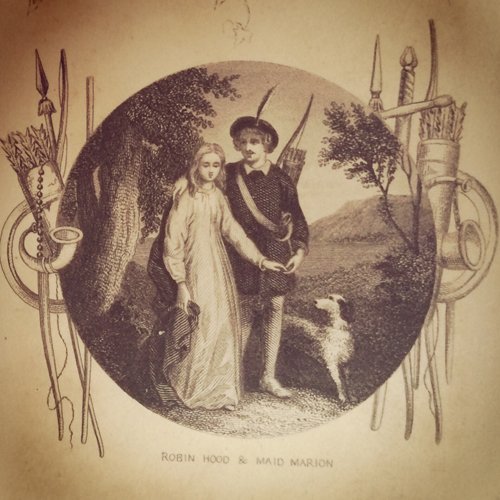 A nineteenth century engraving from Thomas Love Peacock’s novella, Maid Marian, published in 1819; very likely inspired in part by Mary Shelley. [Image link broken]Stephen Knight in his essay on the historical representation of Maid Marian says of Johnson’s depiction: The vigorous real Marian does ultimately defer to Robin's authority, both aristocratic and male, but she is also represented as having real agency, including physical and gendered power. Jonson's sense of Lady Marian's potential power will take centuries to re-emerge …
Knight also states in his introduction: Marian is, it appears, primarily invoked by the gender-related concerns of the social environment in which she appears: she does not resist authority so much as represent a changing alternative to it. In the last few decades her character has steadily grown. As a teen, I remember loving the mid-80s television series Robin of Sherwood, and recall Judi Trott’s Marian as being active and competent. I see on IMDb that there is a new version scheduled for release next year – it will be interesting to see what kind of Maid Marian Eve Hewson makes.
 Enid Bennet plays Lady Marian Fitzwalter opposite Douglas Fairbanks in Robin Hood (1922)
 Olivia de Havilland as Maid Marian, in the 1938 film The Adventures of Robin Hood, also starring Errol FlynnMy (rather stern) Maid Marian was initially inspired by the discovery of a pair of Ralph Lauren suede trousers in an op shop, and a green silk embroidered tunic cut on medieval peasant blouse lines. I’m also wearing a vintage 1940s feathered hat, a wooden bead necklace and a pair of modern green patent leather sling-backs, not very suitable attire for a Marian tramping through Sherbrooke Forest, in the local Mt Dandenong Ranges east of Melbourne! The Maid Marian of legend of course made Sherwood Forest in Nottinghamshire her home, and the similarity in names is very amusing.
 My personal favourite: Judi Trott as Maid Marian in the tv series Robin of Sherwood, which played from 1984–86; sadly the fourth and final series was never made due to finance issues. [Image from Pinterest]If you’re keen to know more about the 700 year history of Robin Hood and, in particular, Maid Marian’s role over the centuries, visit The Robin Hood Project to read Stephen Knight’s full essay. Though long, it is very interesting, easy to read and rewarding. A shorter article at Wikiwand offers as well a detailed breakdown of literature, television and movie versions of the story.
Photo: January 2017
Claire au Contraire
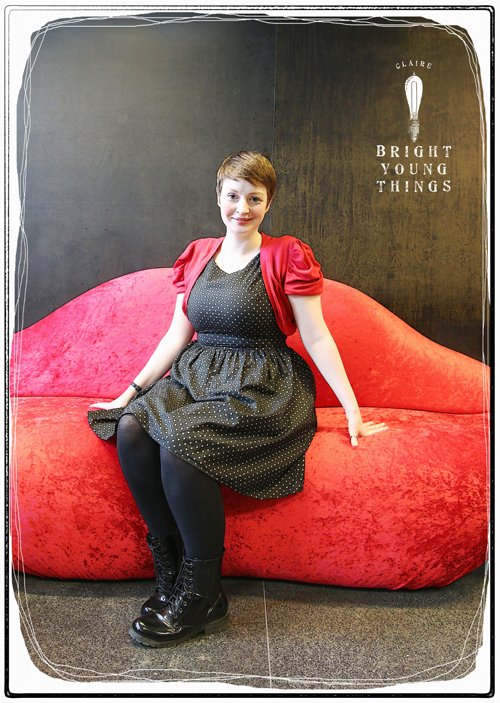 Claire was the receptionist at the theatre where I work once upon a time. She has since moved on, and I miss her cheerful greetings and bubbly personality. Claire has a classic English rose complexion, and wore at the time a pixie hairstyle that suited her so well. It also offset the bright colours and prints she favoured – which I highly appreciated living as I do in a city whose citizens worship black.
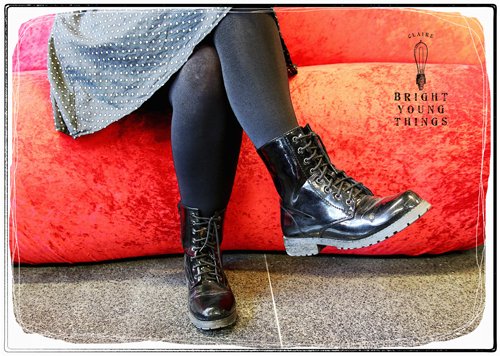
Her self-confessed rebellious streak often pushes her to invert feminine stereotypes with surprise elements, such as the stomping boots she is wearing on this occasion.
Because a receptionist is always busy, we had only a few minutes to quickly snap these photos in the foyer of our workplace, which happens to be graced by a red sofa shaped like a pair of lips – a piece of furniture recycled from a play – a perfect backdrop for a classic red and black outfit. I interview her over lunch in our cafeteria.
Choosing an outfit for the day can be a fraught process for lots of women, and is usually based on many criteria. What was yours this morning, Claire?
I’m going to the theatre straight after work tonight, so I wanted something that would be nice in the evening, and be comfortable to wear all day.
Claire’s self-confessed rebellious streak often pushes her to invert feminine stereotypes
How did you put this outfit together?
I chose the polka dot dress first – it’s by Princess Highway. Then I wanted a solid block of colour to pop against all that black. As the dress has a waist tie, I needed something short to show off the waist, and picked out a bolero jacket. This jersey knit is by Oasis, a British high-street brand. The tights are Voodoo Voluptuous, made for the fuller figure, as otherwise I find tights have a tendency to fall down.
Originally I was shopping for an outfit for a wedding when I stumbled across this dress, and I bought it ‘just because’ – for fun. It was particularly attractive because of the knee length, which is just right for my figure. I don’t like dresses that are too short.
Those boots are quite a contrast though!
Yes, I wore them deliberately to subvert the femininity of the polka dots and puff sleeves. Also, rain was forecast, and I would be doing a lot of walking, so they are very practical.
Are they Doc Martens?
No, they are an inexpensive UK shoe brand, and were a Christmas present from mum last time I visited her in London. The boots I had taken with me on holiday were worn and a bit holey, so mum treated me to a new pair.
You always look super-cute! And your outfits look well thought out. How would you describe your style?
I’ve found one of the most important things in dressing is flattering the figure you have – I’ve come to embrace my pear-shape. The other thing that comes into play is the feminist in me. While I do wear a lot of ‘pretty’ clothes, I like to add an element of surprise and novelty to offset the overt girlishness.
I have been through different fashion phases, such as rockabilly, when I used to wear high-waisted jeans with tops tucked in. But as my body shape has changed, I’ve modified my dress sense with it. Like many people, I own many more clothes that fit me! If I lost some weight, I would double my wardrobe.
What kind of shopper are you?
I am very purposeful. I save up my cash and go shopping when I have something particular I am looking for. I’m actually not very good at mixing and matching, so I pay attention to how things are put together in store displays. I’ll often buy the full outfit: dress, cardigan, shoes that match, and then I’ll wear exactly that way. I find it easier.
What are the items you usually gravitate towards?
I like A-line dresses and skirts, and cute patterns or designs always catch my eye, such as polka dots, or animal graphics. I also have quite a lot of cropped cardigans, and the odd black dress.
Do you have any favourite shops?
I like Princess Highway, because they make clothes that work well for curvy women, and Review for their retro style – they reinterpret vintage well.
I already know that you like vintage. Where do you look?
Definitely! I don’t want to buy everything new. When I am shopping in new retail stores, I am very purposeful, but when it’s vintage I am quite a carefree browser. You don’t know what you’ll find, but you’re certain to come across something that is much more unique.
I mostly shop in my neighbourhood, at Sheila Vintage on Brunswick St (Fitzroy, Melbourne), and also in op shops. I do look online, but it’s too hard to be sure of fit, so I never buy. I own a few vintage dresses that need altering, but I don’t sew, so they just hang in my closet.
You don’t know what you’ll find, but you’re certain to come across something that is much more unique.
A common problem many of us have! Do you have any favourite vintage finds?
Yes, a couple of dresses, a yellow Hawaiian print, and a chequered picnic dress of Italian cotton. Both were bargains at $20 from op shops.
Where do you find your fashion inspirations? Is there anything you’re looking for at the moment?
I look more on Instagram for ideas, rather than magazines. I’m looking for a new winter coat, one with a belted waist. I like the capes coming in at the moment, but it goes against my usual look. I do really need things with long sleeves too.
Ah, coats, I love them. But if you only have one main one, it’s important to get it right. Thank you for sharing your fashion philosophy with us, Claire. It’s been a pleasure!
Now that’s what I call a fairly typical modern shopper with a careful fashion budget: understands her figure, keeps an eye on trends, mixes new with old, and has some irreverent fun too.
Princess Tatiana spoke with Claire in May 2014, subsequently misfiled the photos, and only rediscovered them recently. But Claire still looks good!